
The Evolution of Hair Transplants:
From Plugs to FUE and FUT
Hair restoration has advanced dramatically over the past several decades. What was once an experimental procedure that left patients with “doll’s hair” results has now evolved into highly refined techniques that deliver natural, permanent outcomes. Understanding this history not only shows how far the industry has come but also helps patients make more informed decisions about their own hair restoration journey.
In this post, we’ll explore the evolution of hair transplants — from the early days of plugs to the modern FUT and FUE techniques that dominate the field today.
The Early Days: Hair Plugs (1950s–1980s)
Hair transplantation first gained traction in the 1950s when Dr. Norman Orentreich introduced the concept of “donor dominance” — the idea that transplanted hair retains its original genetic resistance to balding even when moved to thinning areas [1].
These early procedures used large circular grafts, typically 3–4 millimeters in diameter, removed with a punch tool. While groundbreaking, the large grafts often produced unnatural results, earning the nickname “doll’s hair” due to their plug-like appearance [2].
Despite their limitations, plugs paved the way for the next wave of refinement.
Mini- and Micro-Grafting: A Step Forward (1980s–1990s)
By the 1980s, surgeons recognized the need for smaller, more natural-looking grafts. This led to the development of mini- and micro-grafting, which used grafts containing fewer hairs (often 1–4 hairs per graft).
This approach produced softer, more natural hairlines compared to plugs and helped improve density. While still limited compared to today’s methods, it was a key step in the evolution of modern transplantation [3].
FUT: Follicular Unit Transplantation (1990s–2000s)
In the 1990s, Follicular Unit Transplantation (FUT) revolutionized the field. Instead of using plugs or mini-grafts, surgeons began dissecting donor strips into naturally occurring follicular units — groups of 1–4 hairs seen under the microscope [4].
Benefits of FUT:
Ability to transplant thousands of grafts in a single session.
Results that looked more natural than ever before.
Drawback: FUT left a linear scar at the donor site. Though often hidden by surrounding hair, it limited hairstyle options for patients who wanted very short cuts.
Still, FUT quickly became the gold standard in hair restoration during the 1990s and early 2000s.
FUE: Follicular Unit Extraction (2000s–Today)
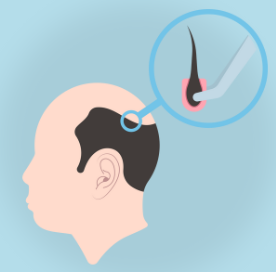
Introduced in the early 2000s, Follicular Unit Extraction (FUE) further advanced the field. Instead of removing a strip of scalp, surgeons extracted follicular units individually using tiny punches less than 1 millimeter in diameter [5].
Benefits of FUE:
No linear scar — only tiny dot scars, often invisible after healing.
Faster recovery and less discomfort.
More flexibility for patients who wear short hairstyles.
While FUE is more time-consuming and often more expensive, its advantages have made it one of the most requested procedures worldwide.
Modern Refinements & Innovations
Hair transplant surgery continues to evolve:
Smaller punches reduce trauma and scarring.
Robotic-assisted FUE systems increase accuracy and efficiency [6].
Combination approaches (FUT + FUE) can maximize graft yield for patients with advanced hair loss.
Improved graft survival rates and artistic hairline design create results indistinguishable from natural hair growth.
What This Means for Patients
Today’s patients benefit from decades of progress. Whether choosing FUT or FUE, modern hair transplants produce natural, permanent results.
FUT may be best for patients who need a larger number of grafts in one session.
FUE is often preferred by those seeking less downtime or who want to avoid a linear scar.
The key is selecting an experienced surgeon who understands both the science and artistry of hair restoration.
Conclusion
From the crude hair plugs of the 1950s to today’s refined FUT and FUE procedures, the evolution of hair transplants is a testament to how far medicine and technology have come. Patients no longer need to fear unnatural results — today’s techniques provide truly natural, lasting outcomes.
At Jernigan’s, we specialize in both FUT and FUE hair restoration tailored to your needs. Schedule a consultation today to explore the best options for your unique hair goals.
References
Orentreich N. Autografts in alopecias and other selected dermatological conditions. Annals of the New York Academy of Sciences. 1959;83:463–479.
Unger WP, Unger RH. Hair transplantation: From punch grafts to follicular unit transplantation. Dermatol Clin. 1999;17(2):333–344.
Bernstein RM, Rassman WR. Follicular transplantation: patient evaluation and surgical planning. Dermatol Surg. 1997;23(9):771–784.
Limmer BL. Elliptical donor stereoscopically assisted micrografting as an approach to further refinement in hair transplantation. Dermatol Surg. 1994;20(9):789–793.
Rassman WR, Bernstein RM, McClellan R, Jones R, Worton E, Uyttendaele H. Follicular unit extraction: minimally invasive surgery for hair transplantation. Dermatol Surg. 2002;28(8):720–728.
Avram MR, Rogers NE. Contemporary hair transplantation. Dermatol Surg. 2009;35(11):1705–1719.